
Leadership Development That Keeps Working
After the Coaching Ends.
Under pressure, leaders don't fall back on what they learned.
They fall back on what's wired.
Sustainable Change Was Never a Knowledge Problem
The problem is that, when under pressure, you and your team aren't responding from learning, you're reacting from survival, from what’s familiar.
That old pattern fires a lot faster than thought, but it can be overridden.
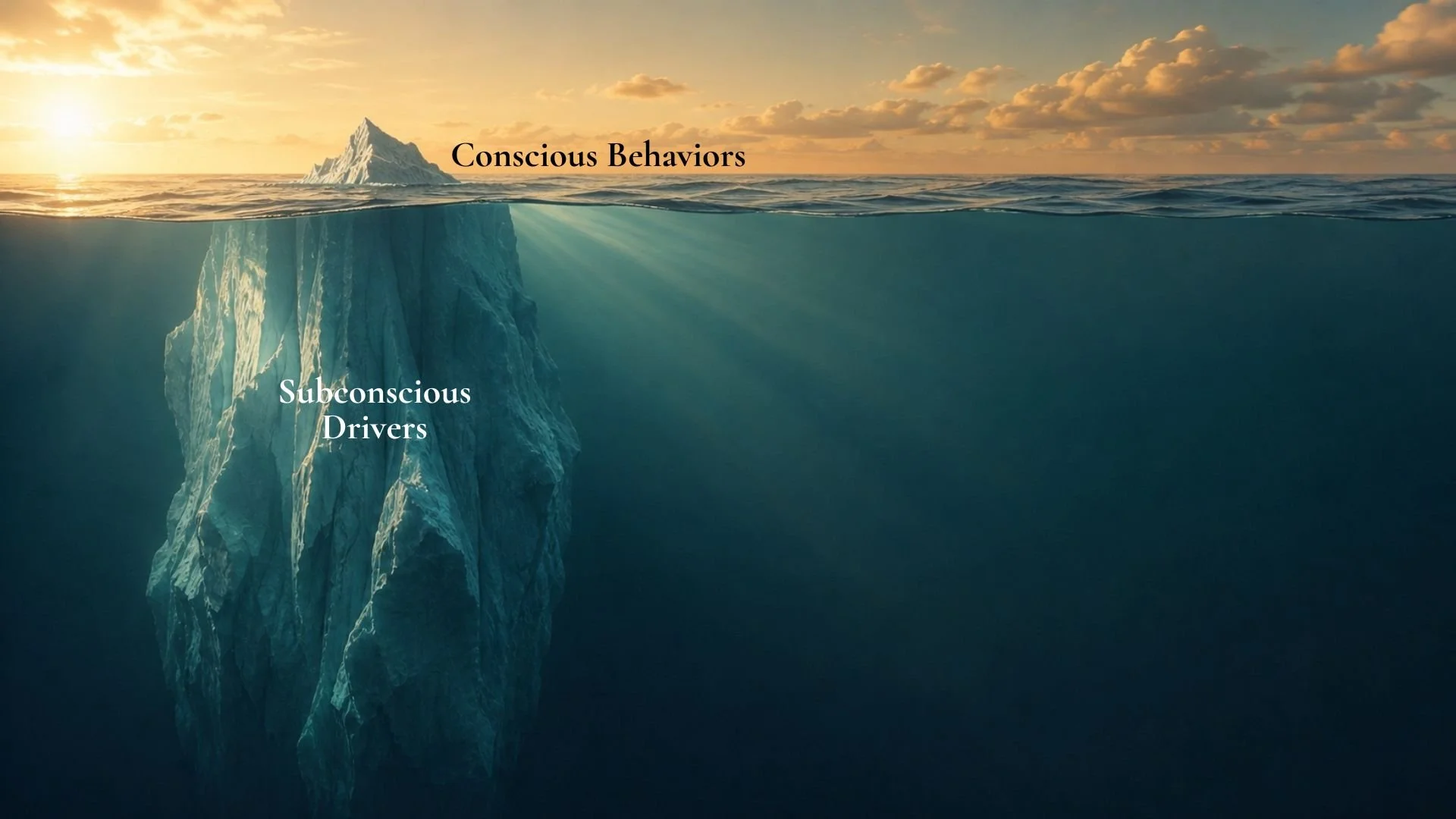
Change Starts With
What's Below the Surface
Learned, habitual patterns run deep,
and they've been running silently for years.
Exploring those waters,
bringing those patterns to awareness,
creates the opportunities both for choice
instead of reaction, and for growth that lasts.
New Behaviors Hold When They're Supported by Deeper Change
As humans, we love to think we make logical, thoughtful decisions. And sometimes, we do. But other times, like when we're under stress, old habits surface from patterns that are based in our beliefs about ourselves and our emotions. Until those drivers are understood, change lasts only as long as the time between crises.
When they are surfaced and brought to conscious awareness they lose their ability to unconsciously drive our decisions and actions. Choices and actions become more consistent and creative, rather than reactive.
But awareness alone can fade under pressure. So the new response gets practiced and anchored at the same depth the old pattern lived, until it becomes what surfaces first. That's what makes the change hold long after the work is done.
Change That Holds,
for the Leader or the Team
For Your Team - On-site
Your team has done the assessments. They know their profiles, their styles, their blind spots. But under pressure they default to the same patterns anyway, because knowing a profile doesn't change what fires first.
Every Conversation is a Scene is built around Everything DiSC® and Agile EQ™, and moves beyond simply understanding behavioral styles. Teams learn to recognize their instinctive responses, read what a conversation actually requires, and stretch beyond their comfortable patterns when the situation calls for something different.
Then they practice it in the room, under real conditions.
Knowing your DiSC style is useful. Being able to choose a different response when the moment demands it is the flexibility that creates collaboration, improves communication, and builds trust.
The teams that communicate well and trust each other are the ones that hold, through pressure, through change, and through the moments that otherwise send good people looking elsewhere.
The half-day focuses on Agile EQ and works best for teams who already have DiSC in place. The full day builds both together, starting with the DiSC foundation in the morning and developing emotional agility on top of it in the afternoon.
Investment:
Half-day (Agile EQ): $7,500 + travel
Full-day (DiSC + Agile EQ): $12,500 + travel
For Your Team - Virtual
The Collaborative Room is a six-week virtual leadership development program that builds a collaborative, coaching environment across a team.
Using Everything DiSC® as a foundation, the work begins where lasting change begins: with the individual. Participants develop greater awareness of how they communicate, respond, make decisions, and show up with others.
From there, the focus moves outward. Teams put that awareness to work through communication, listening, adaptability, and coaching skills that change how they work together in real situations.
Elements of Everything DiSC® Agile EQ™ help participants recognize when their natural response may not be what the moment requires—and develop the flexibility to choose differently.
The result isn't simply a team that understands DiSC. It's a team with a shared language, greater self-awareness, and practical ways to collaborate when the work gets real.
Investment:
Six-week program: $1,500 per participant
For the Individual Leader
One-on-one work for the leader who performs well and still feels the old pattern take over when the stakes rise.
We start with a baseline, often the LPI, to see how others experience your leadership and how you experience it yourself.
Then we go past the behavior to the beliefs driving it. Changing behavior alone is mechanical, and it fades. Changing what's underneath is what makes a new way of leading hold.
This is private, focused work.
The habits that operate under pressure get named, understood, and anchored, so the next time the stakes rise, a different response is already there.
Investment:
Foundation
3 months: $6,500 (includes 1 LPI assessment)
Incubator
6 months: $12,500 (includes 2 LPI assessments)
Accelerator
12 months: $25,000 (includes 3 LPI assessments)
The Work, Proven
These programs have been delivered to enterprise teams, including a publicly traded, multi-billion-dollar entertainment company, and a leading enterprise SaaS company.
“At our board retreat, what impressed me most was Daniel's ability to read people and the room with precision. Rather than forcing consensus, he guided us toward understanding our differences, honoring them, and finding shared purpose within them."
Tiffany Holbrook, President, People 4 Parks
Windsor, CA
"Daniel’s program, The Collaborative Room, masterfully guided us through the key aspects of effective leadership, blending theory with practical application. This program has significantly elevated my ability to coach others with greater impact."
Dr. Tina Udoji, ICF-PCC, Founder & CEO, The Chelis Group, Nigeria
Daniel Olexa, MCC, CIHt. Master Certified Coach, one of the field's most rigorous credentials. Certified Interpersonal Hypnotherapist. DISC and Leadership Practices Inventory (LPI) certified. Co-founder of MCXI (Mindful Coaching eXcellence Institute).
He has trained more than 3,500 coaches across 55 countries.

Questions Leaders Ask
-
Most training works at the level of information.
People learn a model, have a basic understanding of it, and start applying it. But when pressure hits, the old pattern takes over anyway.
This work goes beneath the information, to create an embodied experience, connect to the beliefs, and habits that actually drive behavior under stress.
That's why the change holds after the training ends, instead of fading by the following week.
-
Yes. DISC, Agile EQ, and the Leadership Practices Inventory are part of the work, but they're the starting point, not the destination.
Assessments can only evaluate what they are designed to measure. The leader, a whole human being, is much more nuanced and complex than any assessment can ever score. For me, assessments are a doorway, a foundation, for understanding aspects of leaders.
The real work is changing what's underneath the results, so the growth is lived, not just measured.
-
Both.
Team programs build a shared language and a more collaborative, coaching culture across a group.
One-on-one coaching goes deep with a single leader on the specific patterns that surface under pressure.
Some organizations use one. Many use both.
-
It depends on the work.
One-on-one coaching and The Collaborative Room are delivered virtually.
Every Conversation is a Scene is an on-site, half-day workshop, delivered in your space, which is why travel is billed separately for that program.
-
Because that's the exact problem this work was built to solve.
Training that stays on the surface, at theory level only, and stops at just creating understanding, ultimately fades, because understanding lives in the conscious mind, and the conscious mind is the first thing bypassed under pressure.
The new response has to be anchored deeper than that. When it is, that wisdom can be accessed when the stakes rise, not just remembered in the calm.
-
Change often begins in the first session, when a leader sees a pattern clearly for the first time. But seeing it isn't the same as holding it. The lasting shift comes from practicing and anchoring the new response over the weeks that follow. That's why the engagements are built as containers of time, not one-off events.
To say it another way, you and your teams didn’t get to where you are overnight. It’s the outcome of years of repeated behaviors and corporate culture demands. Light-switch changes rarely sustain; adjustments that are implemented with intention, precision, and consistency can create new outcomes that stick.
-
It's the reason the work reaches deeper than most coaching. Behavior under pressure is driven by imprinted patterns held below conscious awareness. My hypnotherapy background means I can work with leaders directly at that level, where the old pattern lives and where the new one has to be set.
Where other leadership coaches may focus solely on deliverable actions as outcomes, my work goes deeper to overcome possible resistance to change and self-sabotaging behaviors, so that the road to success becomes smoother. The difference in the room is the ability to work beneath the thinking mind, where change actually holds.
Start With a Conversation
Whether it's for you or for your team, the first step is the same. A short conversation to see what's actually going on, and whether this is the work that finally holds.
No pitch. Just a real conversation about the change you want and what it takes to make it last.